On this sunny day in May, we have started an early trek and visited a few significant historical sites in Cavite. We headed first to Kawit, Cavite and then to Rosario, Cavite where the Tejeros Convention was held.

 |
| Casa Hacienda of Tejeros |
 |
| Historical Marker of the Tejeros, Convention |


The Tejeros Convention was held in Casa Hacienda de Tejeros where,
presided by Andres Bonifacio, decided to establish a central
revolutionary government. We stopped to get a better look of the
building. Although it was located along the highway, this big building
seems deserted. When Dennis and I went inside, we saw a few people
who were apparently doing something. They saw us, yes, but did not ask us about our presence in that building. It seemed that they were busy preparing for
an event. We saw the busts of some renowned individuals who have played
a significant role during this event.
 |
| Gen. Mariano M. Alvarez |
 |
| Josephine L. Bracken |
 |
| Don Severino delas Alas |
 |
| Gen. Pascual J. Alvarez |
 |
| Gen. Mariano C. Trias |
 |
| Gat Andres C. Bonifacio |
 |
| Gen. Emilio F. Aguinaldo |
 |
| Gen. Baldomero B. Aguinaldo |
 |
| Gen. Emiliano Riego de Dios |
History says that when
the Revolution broke out on August 23,1896, the Katipunan ceased to be a
secret society. Later in the year, it was proposed that a new
government be established to unite the Katipuneros under a single
leadership. The Magdalo faction nominated Emilio Aguinaldo, a young
Katipunan leader from Kawit. The Magdiwang faction maintained that
Bonifacio, the Katipunan's Supremo, should settle the leadership issue.
Bonifacio was invited to an assembly in Tejeros, Cavite, on March 22,
1897.(Tejeros Convention)
The Trial of the Father of the Revolution
At
the Tejeros Convention, a Revolutionary Government was established with
Aguinaldo as president and Bonifacio as minister of the interior. While
Bonifacio was being proclaimed, Daniel Tirona, a Magdalo, stood up and
questioned his qualifications. A lawyer, he said, should fill that
position. Gravely insulted, Bonifacio, invoking his authority as
presiding officer, declared the proceedings null and void and went on to
establish his own government in Naic, Cavite.
On
Aguinaldo's orders, Bonifacio was arrested in Barrio Limbon in Indang,
Cavite, for refusing to recognize the revolutionary government. Also
arrested were his wife Gregoria and brother Procopio. In the brief but
intense struggle, Bonifacio was stabbed in the throat and grazed by a
bullet on the shoulder. His brother Ciriaco was killed. The wounded
Bonifacio was placed in a hammock and brought back to Naic, along with
Gregoria and Procopio, for a pre-trial hearing. Based
on sufficient cause, a military court was quickly convened in
Maragondon, Cavite, on May 4. The following day, the court charged the
Bonifacio brothers with treason and sedition. On May 6, they were
sentenced to death.(Trial of Bonifacio)

 |
| Bonifacio Trial House |
 |
| "K" in the alibata representing the Katipunan |
 |
| Historical Marker of the Trial House |

 |
| Entrance to the Trial House |
We reached the Trial House of Bonifacio in Poblacion Maragondon, Cavite about 4pm. The house was locked already and so we just contented ourselves looking around the vicinity, taking some shots and reading the historical marker. I was thinking how this neighborhood would have felt like during those times that Andres Bonifacio together with his brother was being tried. Was it a fair trial then?
The
trial house has been turned into a
museum commemorating a significant, if dark, episode in our history.
Its centerpiece is a life-size diorama recreating the trial scene. It was declared a National Heritage Site during the time of former President Joseph Ejercito Estrada. (bonifacio-trial-house)
We so wanted to complete this trek so we pursued and went to Mount Nagpatong although it was already getting late that afternoon. It was not easy travel when we reached the foot of the mountain because the road was rough. Along the way, we asked some few men, if we were on the right track. We passed through two gated stops. The enclosure consisted of bamboos where you have to go down, remove the bamboo one at a time to get in and get down again to put back the bamboos one by one. We learned that they used this to prevent the cows from getting astray outside the vicinity.


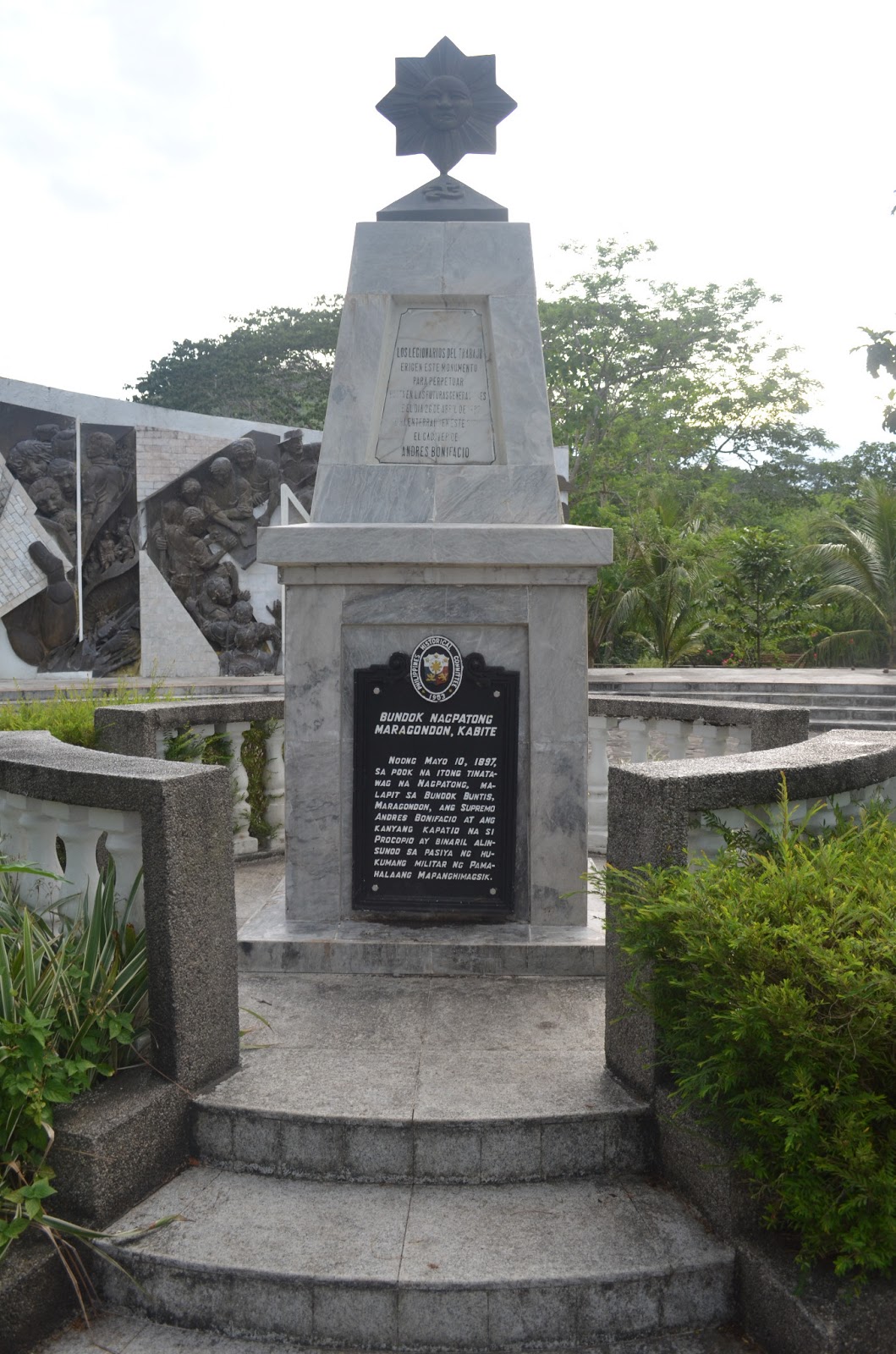
When we reached Mt. Nagpatong, the gate was closed. We forced ourselves in, after attempts of calling because we knew someone was inside, just to take a peek of the site of execution. This was so important to us because this would complete the last leg of our journey about Andres Bonifacio.


 |
| The Execution site of Andres Bonifacio in Mt. Nagpatong, Maragondon, Cavite |
From our research, it was said that on the morning of May 10,1897
the Bonifacio brothers were taken by Major Lazaro Makapagal to Mount
Tala. When they reached Hulog, a barrio in the vicinity of Mount
Nagpatong, Makapagal, upon Bonifacio's insistence, opened his sealed
orders. The order was for the execution of the two brothers, with a
warning of severe punishment should he fail to execute the order. To
this day, the death of the Father of the Revolution remains a
controversial issue in the nation's history.(Mt. Nagpatong)
Although we were not successful in some of the places that we wanted to see, Dennis left a statement "we need to go back". Indeed, I would agree with him because up until now, although I am not really adept about historical events, and he is, I really would want to learn more about the controversial issues between Aguinaldo and Bonifacio. Was Bonifacio, the Father of the Philippine Revolution, really deserving of his death?
Related Links:
http://cavite.info/listing/bonifacio-trial-house.html
http://www.philippinecountry.com/philippineflag.html
http://en.wikipedia.org/wiki/Andr%C3%A9s_Bonifacio
http://philippinereporter.com/2012/06/08/andres-bonifacio-founder-of-katipunan-the-story-behind-his-trial-execution/
http://filipinojournal.com/alberta/our-columnnist/journal-of-philippine-revolution/the-tragedy-of-the-revolution-the-death-of-andres-bonifacio.html
http://malacanang.gov.ph/3330-transcript-of-the-trial-of-andres-bonifacio/


